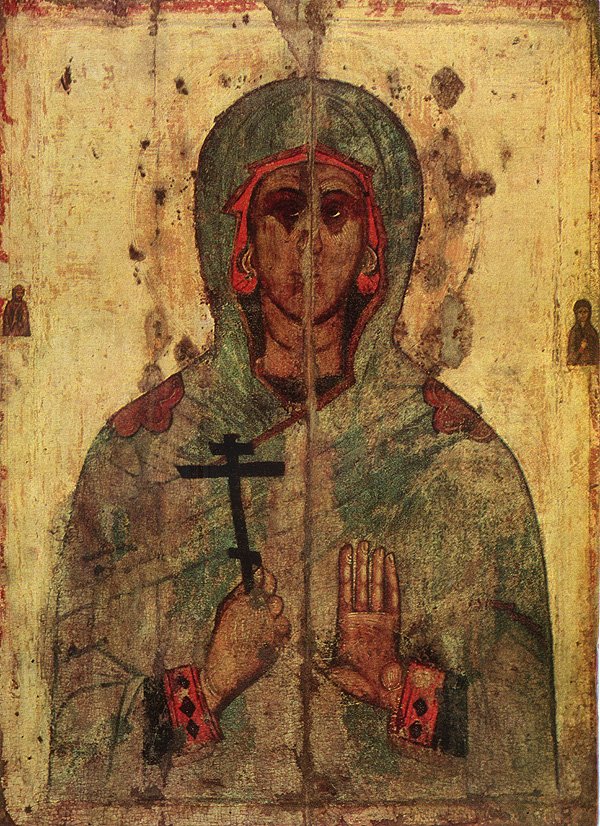
The Holy Virgin Martyr Juliana, daughter of an illustrious pagan named Africanus, was born in the city of Nicomedia. As a child, she was betrothed to a certain Elusius, one of the emperor’s advisors. Saint Juliana was endowed with a profound intellect and goodness of soul. She saw through the delusion and deception of the pagan faith, and secretly accepted holy Baptism.
The Holy Virgin Martyr Juliana, daughter of an illustrious pagan named Africanus, was born in the city of Nicomedia. As a child, she was betrothed to a certain Elusius, one of the emperor’s advisors. Saint Juliana was endowed with a profound intellect and goodness of soul. She saw through the delusion and deception of the pagan faith, and secretly accepted holy Baptism.
When the time of her wedding approached, Juliana refused to be married. Her father urged her not to break her engagement, but when she refused to obey him, he began to beat her viciously. Then Africanus handed his daughter over to the Eparch, who happened to be Elusius, Juliana’s former fiancé. Elusius fervently asked Juliana to marry him, promising not to require her to abandon her faith. Saint Juliana refused and said that she’d rather be put to death.
They beat the saint both long and harshly, but after each beating she received healing and new strength from God. Her punishment took place before a large number of people. Of these, 500 men and 130 women came to confess Christ after witnessing the steadfastness and courage of the holy virgin miraculously healed from her wounds. They were all beheaded, and were baptized in their own blood.
Convinced of the futility of attempting to separate the holy virgin from her heavenly Bridegroom, Eleusius sentenced Juliana to death. She accepted the sentence with joy and glorified the Lord for permitting her to receive a martyr’s crown. The holy Martyr Juliana was executed in the year 304.
Saint Juliana is the subject of an Anglo-Saxon poem, believed to have been written by Cynewulf in the eighth century.
Troparion - Tone 4
All-blameless bride and venerable trophy-bearer, / you are wedded to the Word of the immortal Father, O glorious Juliana. / For having wisely disdained your mortal bridegroom, / you strove beyond nature to destroy the serpent, / and now you delight in the joys of your Bridegroom!
Kontakion - Tone 1
You were a beautiful virgin, wise Juliana, / and as your soul was wounded with divine love, / your body was also pierced with the wounds of martyrdom adorning you as a bride of Christ and His martyr. / Now as you dwell in the heavenly bridal chamber, / you pray for us all.
Our Holy Father Peter, Metropolitan of Moscow (1326)
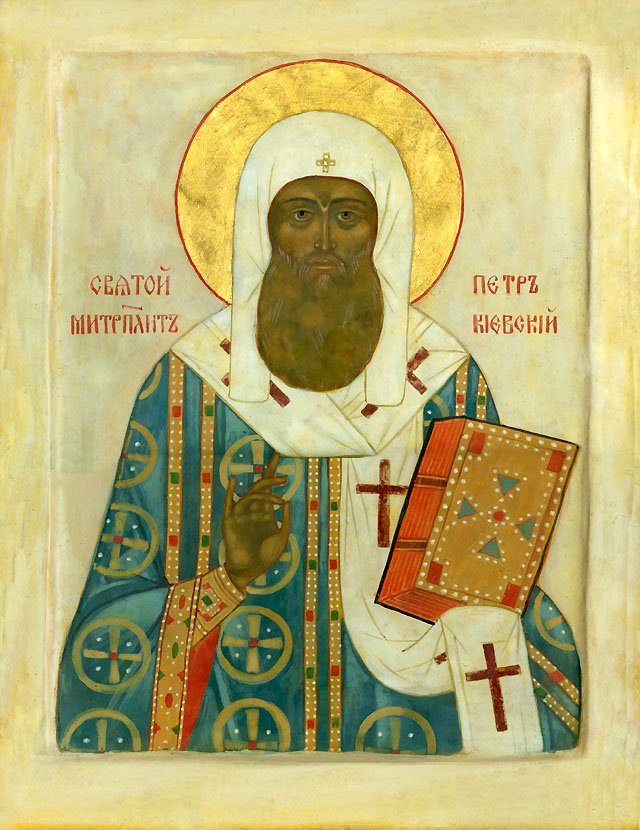
Saint Peter, Metropolitan of Moscow, was born in Volhynia of pious parents, Theodore and Eupraxia. Even before the birth of her son, the Lord revealed to Eupraxia the preordained blessedness of her son. At the age of twelve, young Peter entered a monastery. He successfully studied the book sciences of those times and eagerly fulfilled his monastic obediences.
Saint Peter, Metropolitan of Moscow, was born in Volhynia of pious parents, Theodore and Eupraxia. Even before the birth of her son, the Lord revealed to Eupraxia the preordained blessedness of her son. At the age of twelve, young Peter entered a monastery. He successfully studied the book sciences of those times and eagerly fulfilled his monastic obediences. The future saint devoted much time to an attentive study of the Holy Scriptures, and he also learned iconography. The icons painted by Saint Peter were distributed to the brethren and to Christians who visited the monastery.
Because of his virtuous and ascetic life, the igumen of the monastery had Saint Peter ordained as a hieromonk. After years of ascetic labors at the monastery, the hieromonk Peter, with the blessing of the igumen, left the monastery in search of a solitary place.
He built a cell at the Rata River and began to pursue asceticism in silence. Afterwards, at the place of his ascetic exploits, a monastery was formed, called the Novodvorsk. A church dedicated to the Savior was built for the monks who came to him. Chosen as igumen, Saint Peter guided his spiritual children, and never became angry with a guilty monk. Instead, he instructed the brethren by word and by example. The virtuous igumen and ascetic became known far beyond the vicinity of the monastery. Prince Yuri of Galicia frequently visited the monastery in order to receive spiritual instruction from the holy ascetic.
Once, in his travels through the Russian land, Metropolitan Maximus of Kiev and Vladimir (December 6) visited the monastery with words of instruction and edification. Having received the blessing of Saint Maximus, Saint Peter presented him with an icon of the Dormition of the Most Holy Theotokos, which he had painted. Saint Maximus prayed before the icon for the salvation of the Russian land entrusted to him by God until the end of his days.
When Metropolitan Maximus died, the See of Vladimir remained for a certain time unoccupied. An abbot named Gerontius, aspiring to become the primate of Russia, went to Constantinople with Saint Peter’s vestments, archpastoral staff, and the icon he had painted. The Great Prince of Vladimir, Saint Michael of Tver (November 22), sent him to the Patriarch of Constantinople with a petition that he be appointed as Metropolitan of Russia.
On the suggestion of Prince Yuri of Galicia, Igumen Peter reluctantly went to the Patriarch of Constantinople with a petition that he be consecrated as Metropolitan. God chose Saint Peter to nourish the Russian Church. The Mother of God appeared to Gerontius during a storm on the Black Sea and said, “You labor in vain, for you will never be bishop. The one who painted this icon, the Rata igumen Peter, shall be elevated to the throne of Kiev.”
The words of the Mother of God were fulfilled. Patriarch Athanasius of Constantinople (1289-1293) elevated Saint Peter as Metropolitan of Russia, bestowing upon him the hierarchal vestments, staff and icon, brought by Gerontius. Upon his return to Russia in 1308, Metropolitan Peter arrived at Kiev after a year, and then proceeded on to Vladimir.
The chief hierarch was tested by many trials during his first years of guiding the Russian metropolitanate. Suffering beneath the Tatar (Mongol) Yoke the Russian land was in turmoil, and Saint Peter was often obliged to change the place of his residence. During this period the saint’s labors and concerns to affirm the true Faith and morality in the realm were particularly important. On his journeys throughout the diocese, he incessantly instructed the people and clergy on preserving Christian piety. He also brought quarrelsome princes to peace and unity.
In the year 1312 the saint made a journey to the Horde, where he received a decree from Khan Uzbek, safeguarding the rights of the Russian clergy.
In 1325 Metropolitan Peter, at the request of Great Prince John Kalita (1328-1340), transferred the metropolitan See from Vladimir to Moscow. This event had very great significance for all the Russian land. Saint Peter prophetically predicted deliverance from the Tatar Yoke and that Moscow would become the foremost city in Russia.
With his blessing, the foundation of the cathedral of the Dormition of the Most Holy Theotokos in the Moscow Kremlin was laid in August 1326.
Saint Peter fell asleep in the Lord on December 21, 1326. The holy relics of the saint were buried in the Dormition cathedral in a stone crypt, which he himself had prepared. Many miracles were accomplished through the saint’s prayers. Many healings were even done secretly, which testifies to his profound humility even after death.
The veneration of the first hierarch of the Russian Church was affirmed and spread throughout the Russian land. In 1339, under Saint Theognostus (March 14), Saint Peter was numbered among the saints. Princes kissed the cross on the saint’s tomb as a sign of their fidelity to the Great Prince of Moscow.
As a particularly venerated protector of Moscow, Saint Peter was called on to witness the drawing up of government treaties. The people of Novgorod once had the right of nominating their own bishop in the cathedral of Saint Sophia. After their annexation to Moscow under Ivan III, they swore an oath that henceforth they would only consecrate their archbishops at the grave of Saint Peter the Wonderworker. And it was at the grave of the saint that the first hierarchs of Russia were named and chosen.
The Russian Chronicles mention him frequently, and no significant state undertaking was initiated without prayers at the grave of Saint Peter. The relics of Saint Peter were transferred in 1472 and 1479. In memory of these events, feastdays were established for October 5 and August 24.
Troparion - Tone 4
In truth you were revealed to your flock as a rule of faith, / an image of humility and a teacher of abstinence; / your humility exalted you; / your poverty enriched you. / Hierarch Father Peter, / entreat Christ our God / that our souls may be saved.
Themistocles the Martyr of Myra
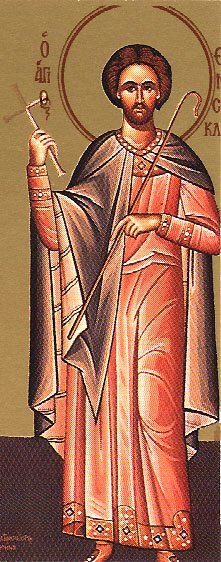
The Holy Martyr Themistocles lived in the city of Myra of Lycia during the reign of the persecutor of Christians, Decius (249-251). Themistocles was a shepherd. During the persecution he concealed within his home a certain Christian named Dioskorides, while he himself went out to the pursuers. They tortured him cruelly, and he received a martyr’s crown for Christ in the year 251.
Troparion - Tone 3
Your holy martyr Themistocles, O Lord, / through his suffering has received an incorruptible crown from You, our God. / For having Your strength, he laid low his adversaries, / and shattered the powerless boldness of demons. / Through his intercessions, save our souls!
Kontakion - Tone 2
You appeared as a bright star announcing Christ with your radiance, / which is repulsive to this world, O Martyr Themistocles; / extinguishing the allure of false gods, / you enlighten the faithful, / always interceding for us all.
Saint Procopius of Vyatka, Fool for Christ (1627)
Blessed Procopius, Fool-for-Christ, of Vyatka, was the son of pious peasants. When Procopius reached age twenty, they wanted him to marry, but he secretly went to the city of Khlynov and took upon himself the feat of foolishness. The holy fool endured hunger, cold, mocking and insults. The Lord glorified him with the gift of clairvoyance. Blessed Procopius died at the age of forty-nine in 1627.
Scripture Readings
☩Epistle
Hebrews 8:7-13
7
For if that first covenant had been faultless, then should no place have been sought for the second.
8
For finding fault with them, he saith, Behold, the days come, saith the Lord, when I will make a new covenant with the house of Israel and with the house of Judah:
9
Not according to the covenant that I made with their fathers in the day when I took them by the hand to lead them out of the land of Egypt; because they continued not in my covenant, and I regarded them not, saith the Lord.
10
For this is the covenant that I will make with the house of Israel after those days, saith the Lord; I will put my laws into their mind, and write them in their hearts: and I will be to them a God, and they shall be to me a people:
11
And they shall not teach every man his neighbour, and every man his brother, saying, Know the Lord: for all shall know me, from the least to the greatest.
12
For I will be merciful to their unrighteousness, and their sins and their iniquities will I remember no more.
13
In that he saith, A new covenant, he hath made the first old. Now that which decayeth and waxeth old is ready to vanish away.
☩Gospel
Mark 9:42-10:1
42
And whosoever shall offend one of these little ones that believe in me, it is better for him that a millstone were hanged about his neck, and he were cast into the sea.
43
And if thy hand offend thee, cut it off: it is better for thee to enter into life maimed, than having two hands to go into hell, into the fire that never shall be quenched:
44
Where their worm dieth not, and the fire is not quenched.
45
And if thy foot offend thee, cut it off: it is better for thee to enter halt into life, than having two feet to be cast into hell, into the fire that never shall be quenched:
46
Where their worm dieth not, and the fire is not quenched.
47
And if thine eye offend thee, pluck it out: it is better for thee to enter into the kingdom of God with one eye, than having two eyes to be cast into hell fire:
48
Where their worm dieth not, and the fire is not quenched.
49
For every one shall be salted with fire, and every sacrifice shall be salted with salt.
50
Salt is good: but if the salt have lost his saltness, wherewith will ye season it? Have salt in yourselves, and have peace one with another.
1
And he arose from thence, and cometh into the coasts of Judea by the farther side of Jordan: and the people resort unto him again; and, as he was wont, he taught them again.
 Meat
Abstain
 Fish
Abstain
 Dairy
Abstain
 Oil
Abstain
 Wine
Abstain