Fasting Rules
 Meat
Abstain
 Fish
Abstain
 Dairy
Abstain
 Oil
Allowed
 Wine
Allowed
Saints & Commemorations
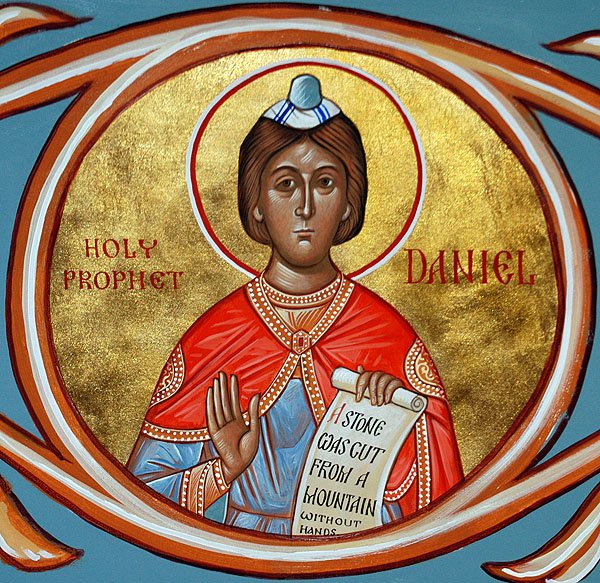
Holy Prophet Daniel and Three Holy Youths
The Holy Prophet Daniel is the fourth of the major prophets.
In the years following 600 B.C. Jerusalem was conquered by the Babylonians, the Temple built by Solomon was destroyed, and many of the Israelite people were led away into the Babylonian Captivity. Among the captives were also the illustrious youths Daniel, Ananias, Azarias and Misael.
King Nebuchadnezzar of Babylon ordered that they be instructed in the Chaldean language and wisdom, and dressed them in finery. Handsome children of princely lineage were often chosen to serve as pages in the palace. For three years, they would be fed from food from the king’s table. After this they would be allowed to stand before his throne. Daniel was renamed Baltasar, Ananias was called Shadrach, Misael was called Mishach, and Azarias was known as Abednego. But they, cleaving to their faith, disdained the extravagance of court, refusing to defile themselves by eating from the king’s table and drinking his wine. Instead, they lived on vegetables and water.
The Lord granted them wisdom, and to Saint Daniel the gift of insight and the interpretation of dreams. The holy Prophet Daniel preserved his faith in the one God and trusted in His almighty help. He surpassed all the Chaldean astrologers and sorcerers in his wisdom, and was made a confidant to King Nebuchadnezzar.
Once, Nebuchadnezzar had a strange dream which terrified him (Daniel 2:1-6). He summoned magicians, sorcerers, and Chaldeans before him to interpret the dream. When they asked him what he had dreamt, the king refused to tell them. He said, “If you do not make known to me the dream and its interpretation, you shall be torn limb from limb, and your houses shall be laid in ruins.” The Babylonian wise men protested that no magician or sorcerer could be expected to do this. Only the gods could reveal the dream and its meaning, they told him.
The king ordered all the wise men of Babylon to be executed. When they sought Daniel and his companions to put them to death, Daniel asked that the king’s sentence not be carried out. He said that he could tell the king what he dreamt, for it had been revealed to him in a vision. Daniel was brought before the king and was able to reveal not only the content of the dream, but also its prophetic significance. After this, the king elevated Daniel to be ruler of the whole province of Babylon, and the chief of all the wise men.
During these times King Nebuchadnezzar ordered a huge statue to be made in his likeness. It was decreed that when people heard the sound of trumpets and other instruments, they should fall down and worship the golden idol. Because they refused to do this, the three holy youths Ananias, Azarias and Misael were cast into a fiery furnace. The flames shot out over the furnace forty-nine cubits, felling the Chaldeans standing about, but the holy youths walked in the midst of the flames, offering prayer and psalmody to the Lord (Daniel 3:26-90).
The Angel of the Lord appeared in the furnace and cooled the flames, and the young men remained unharmed. This “Angel of Great Counsel,” as he is called in iconography, is identified with the Son of God (Daniel 3:25, Isaiah 9:6). In the first Canon for the Nativity of the Lord (Ode 5), the Church sings: “Thou hast sent us Thine Angel of Great Counsel.” The emperor, upon seeing this, commanded them to come out, and was converted to the true God.
Under King Baltasar, Saint Daniel interpreted a mysterious inscription (“Mane, Thekel, Phares”), which had appeared on the wall of the palace during a banquet (Daniel 5:1-31), foretelling the downfall of the Babylonian kingdom. Under the Persian emperor Darius, Saint Daniel was slandered by his enemies, and was thrown into a den with hungry lions, but they did not touch him, and he was not harmed. The emperor Darius then rejoiced over Daniel and ordered people throughout his realm to worship the God of Daniel, “since He is the living and eternal God, and His Kingdom shall not be destroyed, and His dominion is forever” (Daniel 6:26).
The holy Prophet Daniel grieved deeply for his people, who then were undergoing righteous chastisement for a multitude of sins and offenses, for transgressing the laws of God, resulting in the grievous Babylonian Captivity and the destruction of Jerusalem: “My God, incline Thine ear and hearken; open Thine eyes and look upon our desolation and that of Thy city, in which Thy Name is spoken; for we do not make our supplication before Thee because of our own righteousness, but because of Thy great mercy” (Dan 9:18). Because of Daniel’s righteous life and his prayers for the people’s iniquity, the destiny of the nation of Israel and the fate of all the world was revealed to the holy prophet.
While interpreting the dream of King Nebuchadnezzar, the holy, glorious Prophet Daniel spoke of a great and final kingdom, the Kingdom of our Lord Jesus Christ (Dan 2:44). The prophetic vision about the seventy weeks (Dan 9:24-27) speaks about the signs of the First and the Second Comings of the Lord Jesus Christ, and is connected with those events (Daniel 12:1-12).
Saint Daniel interceded for his people before King Cyrus, who esteemed him highly, and who decreed freedom for the Israelite people. Daniel himself and his fellows Ananias, Azarias and Misael, all survived into old age, but died in captivity. According to the testimony of Saint Cyril of Alexandria (June 9), Saints Ananias, Azarias and Misael were beheaded on orders of the Persian emperor Chambyses.
Saint Daniel and the three holy youths are also commemorated on the Sunday of the Holy Forefathers, and on the Sunday of the Holy Fathers (Sunday before the Nativity).
Troparion - Tone 2
Great are the accomplishments of faith, / for the Three Holy Youths rejoiced in the source of the flame, as if by restful waters,1 / and the Prophet Daniel appeared as a shepherd of lions as of sheep. / By their prayers, O Christ God, save our souls.1 Psalm 22/23:2
Kontakion - Tone 3
Great are the accomplishments of faith, / for the Three Holy Youths rejoiced in the source of the flame, as if by restful waters,1 / and the Prophet Daniel appeared as a shepherd of lions as of sheep. / By their prayers, O Christ God, save our souls.
Our Holy Father Dionysius the New of Zakinthos (1624)
He was born to pious and wealthy parents on the island of Zakinthos. Early in life he renounced his wealth and worldly honors to enter monastic life. His virtue became so well known that he was appointed Archbishop of Aegina, where he served for many years. In time, in order to retire to a life of solitude and struggle, he resigned and returned to his homeland where he entered a monastery in the mountains.
He was born to pious and wealthy parents on the island of Zakinthos. Early in life he renounced his wealth and worldly honors to enter monastic life. His virtue became so well known that he was appointed Archbishop of Aegina, where he served for many years. In time, in order to retire to a life of solitude and struggle, he resigned and returned to his homeland where he entered a monastery in the mountains. Here he received the grace of performing miracles, and worked many healing and saving wonders among the people of Zakinthos.
A story from the Synaxarion reveals his character as one truly united to Christ: “He excelled above all in love of neighbour and in meekness. One day the murderer of the Saint’s own brother, fleeing the law and the members of his victim’s family, arrived at the monastery and begged Dionysius for asylum, little knowing to whom he was speaking. On gathering the reason for his flight and that his own brother was the victim, the man of God resisted with all his strength his natural grief and the temptation to avenge the crime. Imitating Christ, who pardoned his enemies and prayed for his persecutors, he received the fugitive with compassion, comforted him, exhorted him to repent and hid him in an out-of-the-way cell. When his pursuing kinsmen reached the monastery with the dreadful news, the Saint did not reveal that he knew it already, but did his best with words of peace to allay the wrath of his relatives and their desire for vengeance. As soon as they moved off, he let out the murderer (who was amazed and terror-struck before such superhuman goodness) and having provided him with victuals and money for his journey, he sent him away to work freely at the salvation of his soul.”
The holy bishop reposed in 1622 after a long and painful illness. He has continued to work signs and miracles and to appear from time to time to the people of Zakinthos, who venerate him as their protector and patron.
Scripture Readings
☩Epistle
Hebrews 7:1-6
1
For this Melchisedec, king of Salem, priest of the most high God, who met Abraham returning from the slaughter of the kings, and blessed him;
2
To whom also Abraham gave a tenth part of all; first being by interpretation King of righteousness, and after that also King of Salem, which is, King of peace;
3
Without father, without mother, without descent, having neither beginning of days, nor end of life; but made like unto the Son of God; abideth a priest continually.
4
Now consider how great this man was, unto whom even the patriarch Abraham gave the tenth of the spoils.
5
And verily they that are of the sons of Levi, who receive the office of the priesthood, have a commandment to take tithes of the people according to the law, that is, of their brethren, though they come out of the loins of Abraham:
6
But he whose descent is not counted from them received tithes of Abraham, and blessed him that had the promises.
☩Gospel
Mark 9:10-16
10
And they kept that saying with themselves, questioning one with another what the rising from the dead should mean.
11
And they asked him, saying, Why say the scribes that Elias must first come?
12
And he answered and told them, Elias verily cometh first, and restoreth all things; and how it is written of the Son of man, that he must suffer many things, and be set at nought.
13
But I say unto you, That Elias is indeed come, and they have done unto him whatsoever they listed, as it is written of him.
14
And when he came to his disciples, he saw a great multitude about them, and the scribes questioning with them.
15
And straightway all the people, when they beheld him, were greatly amazed, and running to him saluted him.
16
And he asked the scribes, What question ye with them?
Liturgical data sourced from OCA.org and orthocal.info