Fasting Rules
 Meat
Abstain
 Fish
Abstain
 Dairy
Abstain
 Oil
Allowed
 Wine
Allowed
Saints & Commemorations
Hieromartyr Eleutherius of Illyria
His name is a form of the Greek word for “freedom.” He was a native of Rome whose father died at a young age, leaving him to be brought up by his mother Anthia, a Christian who reared him in the fear of God and the love of holiness. His virtue and ability were so evident that he was ordained a priest at the age of seventeen and at twenty was made Bishop of Illyria, a large see roughly comprising modern-day Serbia.
The
His name is a form of the Greek word for “freedom.” He was a native of Rome whose father died at a young age, leaving him to be brought up by his mother Anthia, a Christian who reared him in the fear of God and the love of holiness. His virtue and ability were so evident that he was ordained a priest at the age of seventeen and at twenty was made Bishop of Illyria, a large see roughly comprising modern-day Serbia.
The young bishop’s pastoral and evangelistic work was so successful that many pagans were converted to the Faith through him. His growing reputation drew the attention of the Emperor Hadrian, who sent one of his senior officers named Felix to arrest the holy bishop. But when Felix saw and heard Eleutherius, he was captivated by his teaching, believed in Christ, and was baptized. He and the St Eleutherius returned and presented themselves together before the Emperor, fearlessly confessing their faith.
Eleutherius was subjected to brutal torture, during which the city prefect Coremonus, who had suggested some of the tortures, was enlightened through the Saint’s prayers for his enemies, and proclaimed Christ. He was baptized by Eleutherius and later beheaded. After a time, when it became clear that fire and torture would not move the holy bishop, he was taken to the amphitheater and beheaded. At the moment of his death, his mother Anthia rushed forward and took his body in her arms. There she also was beheaded by the executioners.
Pregnant women call on St Eleutherius that they may have a safe delivery.
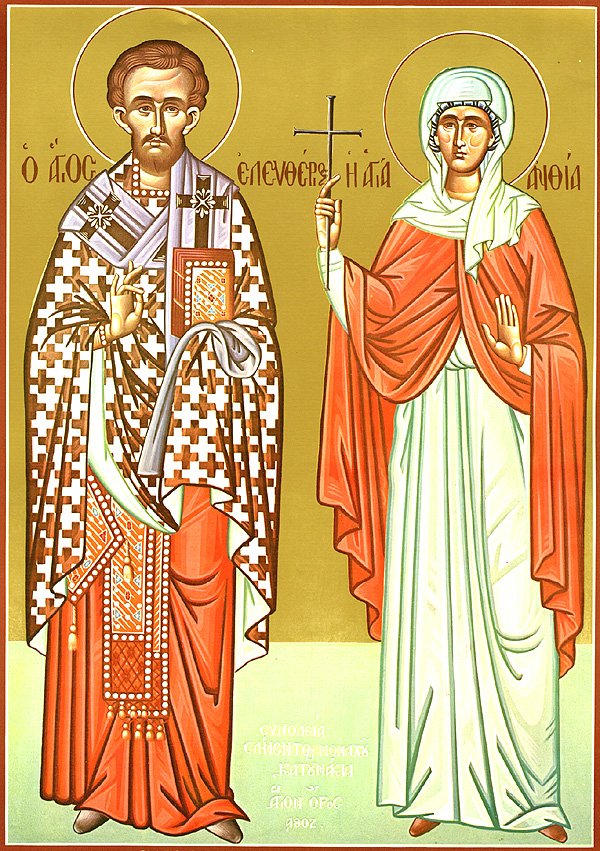
Hieromartyr Eleutherius of Illyria and his mother, Martyr Evanthia
Saint Eleutherius, the son of an illustrious Roman citizen, was raised in Christian piety by his mother. His virtue was such that at the age twenty, he had been elevated to bishop of Illyria. In the reign of the emperor Hadrian, Saint Eleutherius was tortured for his bold preaching about Christ, then was beheaded at Rome with his mother Evanthia.
Saint Eleutherius, the son of an illustrious Roman citizen, was raised in Christian piety by his mother. His virtue was such that at the age twenty, he had been elevated to bishop of Illyria. In the reign of the emperor Hadrian, Saint Eleutherius was tortured for his bold preaching about Christ, then was beheaded at Rome with his mother Evanthia. The Eparch Caribus, who had tortured Saint Eleutherius, also came to believe in Christ and was executed.
Troparion - Tone 5
Adorned with the robe of priest / stained with the streams of your blood, / O wise and blessed Eleutherius, over-thrower of Satan / you hastened to Christ your Master. / Pray unceasingly for those who faithfully honor your contest!
Kontakion - Tone 2
We all praise and entreat you, O Hieromartyr Eleutherius, / adornment of priests and encouragement of martyrs: / Free from danger those who lovingly celebrate your memory, / and pray unceasingly for us all!
St Stephen of Surozh
Holy Martyr Eleutherius the Cubicularius (4th c.)
He was from a noble family in Constantinople, and rose to the rank of Cubicularius (Chamberlain). He was not only a counselor to, but a close friend of, the Emperor (probably Julian the Apostate). But Eleutherius was increasingly moved by a desire to become a Christian; so, obtaining a leave from the Imperial court, he moved to the countryside in Bithynia, where he was baptized.
He was from a noble family in Constantinople, and rose to the rank of Cubicularius (Chamberlain). He was not only a counselor to, but a close friend of, the Emperor (probably Julian the Apostate). But Eleutherius was increasingly moved by a desire to become a Christian; so, obtaining a leave from the Imperial court, he moved to the countryside in Bithynia, where he was baptized. There he built a house that concealed an underground chapel.
When Eleutherius returned to court, some jealous courtiers denounced him to the Emperor, who visited Eleutherius’ country house and was furious to discover the underground church. When the Saint would not renounce his faith in Christ, the Emperor, ignoring all previous bonds of friendship, had him beheaded.
Holy Martyr Bacchus the New (787)
During the reign of Constantine VI and Irene, restorers of the holy icons, the Holy Land was under the control of the Muslim Arabs. Many Christians there apostatized, putting honors and security in this world above their eternal joy. One of these was the father of this Saint, who brought up seven children as Muslims.
During the reign of Constantine VI and Irene, restorers of the holy icons, the Holy Land was under the control of the Muslim Arabs. Many Christians there apostatized, putting honors and security in this world above their eternal joy. One of these was the father of this Saint, who brought up seven children as Muslims. His wife however, never renounced her Faith and prayed constantly for the conversion of her husband and children. Upon the death of the father, her third son Dachak declared that he wished to become a Christian. He was baptized in the Monastery of St Sabas near Jerusalem, receiving the name Bacchus, and determined to be a monk. But the abbot, fearing reprisals against the Monastery, sent him back to his home in Jerusalem. His brothers, seeing his joy and boldness in confessing the Faith, decided to receive holy Baptism, except for one, who denounced Bacchus to the authorities. He was arrested and brought before the judge and, when he proved steadfast in his confession of Christ, was beheaded.
Our Venerable Father Tryphon of Kola, apostle of Laponia (1583), and his disciple the Holy Martyr Jonah (1590)
Saint Jonah of Pechenga and Kola was, as tradition tells us, a priest in the city of Kola. After the death of his daughter and wife he went off to the Pechenga-Trinity monastery near Kola, and became a disciple of its founder, Saint Tryphon. After the death of his teacher, he settled in 1583 at the site of what was to become his grave in the
Saint Jonah of Pechenga and Kola was, as tradition tells us, a priest in the city of Kola. After the death of his daughter and wife he went off to the Pechenga-Trinity monastery near Kola, and became a disciple of its founder, Saint Tryphon. After the death of his teacher, he settled in 1583 at the site of what was to become his grave in the neighboring Dormition wilderness, where he was killed by the Swedes in the year 1590.
Troparion - Tone 4
Your holy martyr Jonah, O Lord, / through his suffering has received an incorruptible crown from You, our God. / For having Your strength, he laid low his adversaries, / and shattered the powerless boldness of demons. / Through his intercessions, save our souls!
Kontakion - Tone 2
You appeared as a bright star announcing Christ with your radiance, / which is repulsive to this world, O Martyr Jonah; / extinguishing the allure of false gods, / you enlighten the faithful, / always interceding for us all.
Scripture Readings
☩Epistle
Hebrews 4:1-13
1
Let us therefore fear, lest, a promise being left us of entering into his rest, any of you should seem to come short of it.
2
For unto us was the gospel preached, as well as unto them: but the word preached did not profit them, not being mixed with faith in them that heard it.
3
For we which have believed do enter into rest, as he said, As I have sworn in my wrath, if they shall enter into my rest: although the works were finished from the foundation of the world.
4
For he spake in a certain place of the seventh day on this wise, And God did rest the seventh day from all his works.
5
And in this place again, If they shall enter into my rest.
6
Seeing therefore it remaineth that some must enter therein, and they to whom it was first preached entered not in because of unbelief:
7
Again, he limiteth a certain day, saying in David, To day, after so long a time; as it is said, To day if ye will hear his voice, harden not your hearts.
8
For if Jesus had given them rest, then would he not afterward have spoken of another day.
9
There remaineth therefore a rest to the people of God.
10
For he that is entered into his rest, he also hath ceased from his own works, as God did from his.
11
Let us labour therefore to enter into that rest, lest any man fall after the same example of unbelief.
12
For the word of God is quick, and powerful, and sharper than any twoedged sword, piercing even to the dividing asunder of soul and spirit, and of the joints and marrow, and is a discerner of the thoughts and intents of the heart.
13
Neither is there any creature that is not manifest in his sight: but all things are naked and opened unto the eyes of him with whom we have to do.
☩Gospel
Mark 8:22-26
22
And he cometh to Bethsaida; and they bring a blind man unto him, and besought him to touch him.
23
And he took the blind man by the hand, and led him out of the town; and when he had spit on his eyes, and put his hands upon him, he asked him if he saw ought.
24
And he looked up, and said, I see men as trees, walking.
25
After that he put his hands again upon his eyes, and made him look up: and he was restored, and saw every man clearly.
26
And he sent him away to his house, saying, Neither go into the town, nor tell it to any in the town.
Liturgical data sourced from OCA.org and orthocal.info