Fasting Rules
 Meat
Abstain
 Fish
Abstain
 Dairy
Abstain
 Oil
Abstain
 Wine
Abstain
Saints & Commemorations
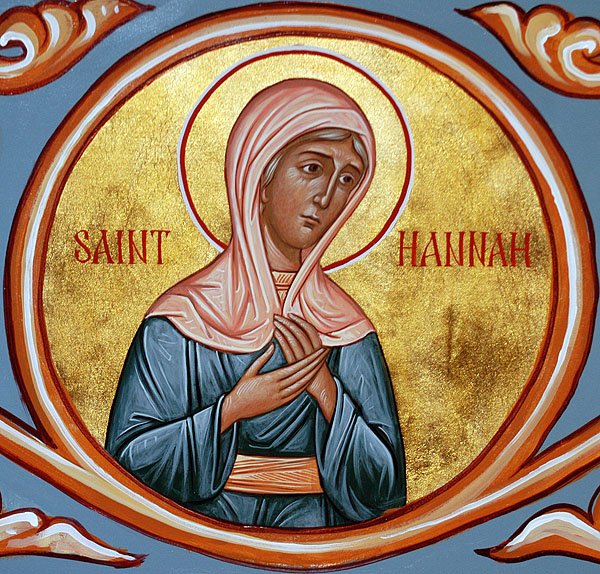
St Hannah (Anna), the Prophetess, the mother of the Prophet Samuel (12th c. BC)
The Holy Prophetess Hannah dwelt in marriage with Elkanah, but she was childless. Elkanah took to himself another wife, Phennena, who bore him children. Hannah grieved strongly over her misfortune, and every day she prayed for an end to her barrenness, and vowed to dedicate her child to God.
Once, as she prayed fervently in the Temple, the priest Heli thought that she was drunk, and he began to reproach her.
The Holy Prophetess Hannah dwelt in marriage with Elkanah, but she was childless. Elkanah took to himself another wife, Phennena, who bore him children. Hannah grieved strongly over her misfortune, and every day she prayed for an end to her barrenness, and vowed to dedicate her child to God.
Once, as she prayed fervently in the Temple, the priest Heli thought that she was drunk, and he began to reproach her. But the saint poured out her grief, and after she received a blessing, she returned home. After this Hannah conceived and gave birth to a son, whom she named Samuel (which means “Asked from God”).
When the child reached the age of boyhood, the mother herself presented him to the priest Heli, and Samuel remained with him to serve before the Tabernacle (1 Kings/1 Samuel 2: 1-21).
Troparion - Tone 2
We celebrate the memory / of Your prophetess Hannah, O Lord; / through her we entreat You, / save our souls.
Kontakion - Tone 4
Enlightened by the Spirit, your pure heart became the dwelling place of most splendid prophecy; / for you saw things far off as if they were near. / Therefore, we honor you, blessed and glorious Prophetess Hannah.
St Stephen the New Light (Neolampes) of Constantinople (912)
Saint Stephen the “New Light” was born at Constantinople in 838 and received a fine education. Under Patriarch Methodius, Stephen received monastic tonsure and shut himself in a cell attached to the church of Saint Peter in Constantinople. Later he went into seclusion, and over fifty years he constantly increased his ascetic efforts.
To
Saint Stephen the “New Light” was born at Constantinople in 838 and received a fine education. Under Patriarch Methodius, Stephen received monastic tonsure and shut himself in a cell attached to the church of Saint Peter in Constantinople. Later he went into seclusion, and over fifty years he constantly increased his ascetic efforts.
Toward the end of his life the saint acquired great grace from the Lord, shining in the constellation of the saints like the ancient ascetics of the Orthodox Church, so that he came to be called the “New Light.” According to the Prologue, he died in the year 912 and was buried in the church of Saint Antipas.
Troparion - Tone 8
By a flood of tears you made the desert fertile, / and your longing for God brought forth fruits in abundance. / By the radiance of miracles you illumined the whole universe! / O our holy father Stephen, pray to Christ our God to save our souls!
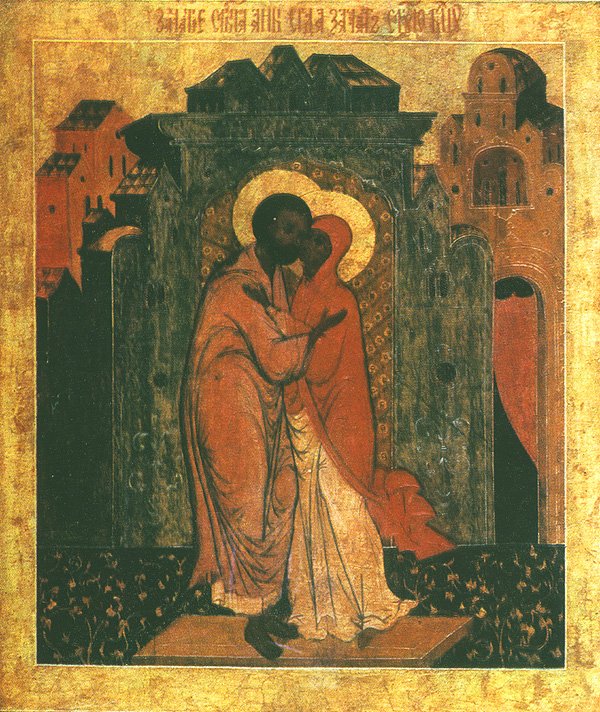
Conception by St Anna of the Theotokos
The Gospels and other books of the New Testament do not mention anything about Saint Anna, the mother of the Theotokos. According to Tradition, the priest Matthan (Matthew 1:15), a resident of Bethlehem, had three daughters: Mary, 1 Sobe (Sobḗ), and Anna. Mary was married in Bethlehem, where she gave birth to Elizabeth, the mother of Saint John the Baptist.
The Gospels and other books of the New Testament do not mention anything about Saint Anna, the mother of the Theotokos. According to Tradition, the priest Matthan (Matthew 1:15), a resident of Bethlehem, had three daughters: Mary, 1 Sobe (Sobḗ), and Anna. Mary was married in Bethlehem, where she gave birth to Elizabeth, the mother of Saint John the Baptist.
The Holy Righteous Anna was the youngest daughter of the priest Matthan, who was from the tribe of Levi, of the family of Aaron. Her husband, the Holy Righteous Joachim was from the tribe of Judah, from the house and family of King David. According to the ancient promise, the Messiah was to come from the lineage of King David (Luke 2:4).
The couple lived in Nazareth of Galilee. Every year, they gave two-thirds of their income to the Temple in Jerusalem, and to the poor. By God's Providence, the holy couple had no children until their old age. They were greatly saddened by this, since the Jews considered childlessness a great misfortune and a punishment from God. They prayed fervently for the Lord to give them children.
On a certain feast, when the Israelites were bringing gifts to God in the Temple at Jerusalem, the High Priest, believing that the childless Joachim did not have God's blessing, refused to accept gifts from him. Saint Joachim was grief stricken. He consulted the genealogy of the twelve tribes of Israel and ascertained that all righteous men had offspring, including Abraham, when he was a hundred years old. Without returning home, Saint Joachim went into the wilderness and spent forty days there in strict fasting and prayer, entreating God's mercy for himself, and washing away his disgrace with bitter tears.
Saint Anna thought that she was to blame for their sorrow. One day saw a nest with barely fledged chicks in the branches of a laurel tree, she wept and prayed for the gift of a child, promising to bring the infant to God as an offering. As soon as Saint Anna spoke these words, an Angel of the Lord told her that her prayer had been answered, and revealed that she would have a daughter named Mary, through whom all the peoples of the world would be blessed. Rejoicing, Saint Anna hastened to the Temple in Jerusalem, in order to give thanks to God. She repeated her vow to dedicate the child to Him. An Angel came to Saint Joachim in the wilderness with the same news and commanded him to go to Jerusalem. There, the Righteous Anna conceived and gave birth to the Most Holy Theotokos.
The Orthodox Church does not accept the teaching that the Mother of God was exempted from the consequences of ancestral sin (death, corruption, sin, etc.) at the moment of her conception by virtue of the future merits of her Son. Only Christ was born perfectly holy and sinless, as Saint Ambrose of Milan teaches in Chapter Two of his Commentary on the Gospel of Saint Luke. The Holy Virgin was like everyone else in her mortality, and in being subject to temptation, although she committed no personal sins. She was not a deified creature removed from the rest of humanity. If this were the case, She would not have been truly human, and the nature that Christ took from her would not have been truly human either. If Christ does not truly share our human nature, then the possibility of our salvation is in doubt.
Saint Anna has been honored since ancient times. We infer this from various Fathers of the Church, and also from ancient hymns in honor of the mother of the Theotokos. In the year 550, Emperor Justinian dedicated a temple in Constantinople to Saint Anna.
Part of the Saint's left hand is located in Stavronikita Monastery on Mount Athos. Part of the Saint's incorrupt left foot is located in Saint Anna's Skete on Mount Athos. Part of the Saint's incorrupt right foot is located in the Monastery of Koutloumousiou on Mount Athos.
Fragments of the Saint's Holy Relics are to be found in Saint Anna's Monastery at Lygaria in Lamia, and also in the Monastery of Saint John the Theologian at Sourotis.
Some of the Saint's incorrupt flesh is in the Roman Catholic International Crusaders Collection of Holy Relics. The Saint's wrist is to be found in the Roman Catholic church of Saint Paul "Outside the Walls" in Rome.
Many icons of the Conception by Saint Anna show the Most Holy Theotokos trampling the serpent underfoot. Saints Joachim and Anna are usually depicted with hands folded in prayer; their eyes are also directed upward and they contemplate the Mother of God, who stands in the air with outstretched hands; under her feet is an orb encircled by a serpent (symbolizing the devil), which strives to conquer the universe by its power.”
There are also icons in which Saint Anna holds the Most Holy Virgin on her left arm as an infant. On Saint Anna’s face is a look of reverence. A large ancient icon, painted on canvas, is located in the village of Minkovetsa in the Dubensk district of Volhynia Diocese. From ancient times this Feast was especially venerated by pregnant women in Russia.
1 This Mary is the mother of Saint Anna, and the grandmother of the Theotokos. She is commemorated on the Sunday of the Forefathers.
Troparion - Tone 4
Today the bonds of childlessness are loosed, / for having heard Joachim and Anna, / God clearly assures them of the birth of the Mother of God, / from whom He Himself, the Uncircumscribed One, was born, / becoming man when He commanded the Angel to cry out: / “Hail, full of grace, / the Lord is with you.”
Kontakion - Tone 4
Today, the inhabited earth celebrates Anna's conception, which was from God, / for she gave birth to her who, beyond understanding,1 gave birth to the Word.1 Canon of Preparation for Holy Communion, Ode VII (after “Glory ... now and ever.”)
Scripture Readings
☩Epistle
2 Timothy 4:9-22
9
Do thy diligence to come shortly unto me:
10
For Demas hath forsaken me, having loved this present world, and is departed unto Thessalonica; Crescens to Galatia, Titus unto Dalmatia.
11
Only Luke is with me. Take Mark, and bring him with thee: for he is profitable to me for the ministry.
12
And Tychicus have I sent to Ephesus.
13
The cloke that I left at Troas with Carpus, when thou comest, bring with thee, and the books, but especially the parchments.
14
Alexander the coppersmith did me much evil: the Lord reward him according to his works:
15
Of whom be thou ware also; for he hath greatly withstood our words.
16
At my first answer no man stood with me, but all men forsook me: I pray God that it may not be laid to their charge.
17
Notwithstanding the Lord stood with me, and strengthened me; that by me the preaching might be fully known, and that all the Gentiles might hear: and I was delivered out of the mouth of the lion.
18
And the Lord shall deliver me from every evil work, and will preserve me unto his heavenly kingdom: to whom be glory for ever and ever. Amen.
19
Salute Prisca and Aquila, and the household of Onesiphorus.
20
Erastus abode at Corinth: but Trophimus have I left at Miletum sick.
21
Do thy diligence to come before winter. Eubulus greeteth thee, and Pudens, and Linus, and Claudia, and all the brethren.
22
The Lord Jesus Christ be with thy spirit. Grace be with you. Amen. The second epistle unto Timotheus, ordained the first bishop of the church of the Ephesians, was written from Rome, when Paul was brought before Nero the second time.
☩Gospel
Luke 21:5-7, 10-11, 20-24
5
And as some spake of the temple, how it was adorned with goodly stones and gifts, he said,
6
As for these things which ye behold, the days will come, in the which there shall not be left one stone upon another, that shall not be thrown down.
7
And they asked him, saying, Master, but when shall these things be? and what sign will there be when these things shall come to pass?
10
Then said he unto them, Nation shall rise against nation, and kingdom against kingdom:
11
And great earthquakes shall be in divers places, and famines, and pestilences; and fearful sights and great signs shall there be from heaven.
20
And when ye shall see Jerusalem compassed with armies, then know that the desolation thereof is nigh.
21
Then let them which are in Judea flee to the mountains; and let them which are in the midst of it depart out; and let not them that are in the countries enter thereinto.
22
For these be the days of vengeance, that all things which are written may be fulfilled.
23
But woe unto them that are with child, and to them that give suck, in those days! for there shall be great distress in the land, and wrath upon this people.
24
And they shall fall by the edge of the sword, and shall be led away captive into all nations: and Jerusalem shall be trodden down of the Gentiles, until the times of the Gentiles be fulfilled.
Liturgical data sourced from OCA.org and orthocal.info